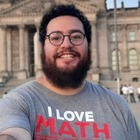
I am Ricardo Rodriguez Reveco, a PhD student in the Symmetric Cryptography group of Ruhr-Universität Bochum, supervised by Gregor Leander. I study whether the assumptions behind cryptanalysis actually hold: for example, whether wrong keys behave like random ones in key-recovery attacks, or whether conjectured properties of primitives built on χ (the nonlinear map in SHA-3) are true. More broadly, I am interested in Fourier analysis of Boolean functions and its uses in cryptography and learning theory.
Google Scholar · ORCID · GitHub
Papers
- Settling Conjectures on Linear Structures of Inverse ChiChi Generalizations: Four Proofs and a Counterexample (with Hui Wang and Kai Hu). Preprint, 2026.
ChiChi is the nonlinear layer of the low-latency cipher ChiLow. We settle five open conjectures about the inverses of its generalizations: four are true, and the fifth is false.
PDF · ePrint 2026/2379 · BibTeX - A Quasidifferential Analysis of the Wrong-Key Randomization Hypothesis (with Tim Beyne, Gregor Leander and Mariia Mutkovina). IACR Transactions on Symmetric Cryptology (ToSC) 2026, Issue 3.
Differential attacks assume that wrong key guesses behave like a random permutation. We compute the exact wrong-key distribution for PRESENT and GIFT and show that the assumption is false, although Wang’s 14-round differential attack on PRESENT is not affected.
PDF · DOI · ePrint 2026/1848 · BibTeX · Slides (HGI 2025 lightning talk)
Talks
- Data Complexity and Key Recovery in Differential Cryptanalysis. Lightning talk at the HGI Cybersecurity Day 2025, Bochum. Slides
About me
Before my PhD, I was a graduate student at PUC-Chile and the Millennium Institute for Foundational Research on Data, and worked as a part-time lecturer at Universidad Adolfo Ibáñez and PUC.
My research interests are broad, mainly about cryptanalysis and the use of automated tools for it (SAT/SMT/MILP).
I studied mathematics as an undergraduate at Pontificia Universidad Católica de Chile, and did a master’s degree in computer science supervised by Prof. Marcelo Arenas. Marcelo and I worked on FPRAS algorithms for counting problems in the complexity class #P. Previously, we worked on a complexity analysis of a formalization of Schelling’s model of segregation and on combinatorial problems related to blockchains.